
Your skin needs more moisturiser in summer. Not less.
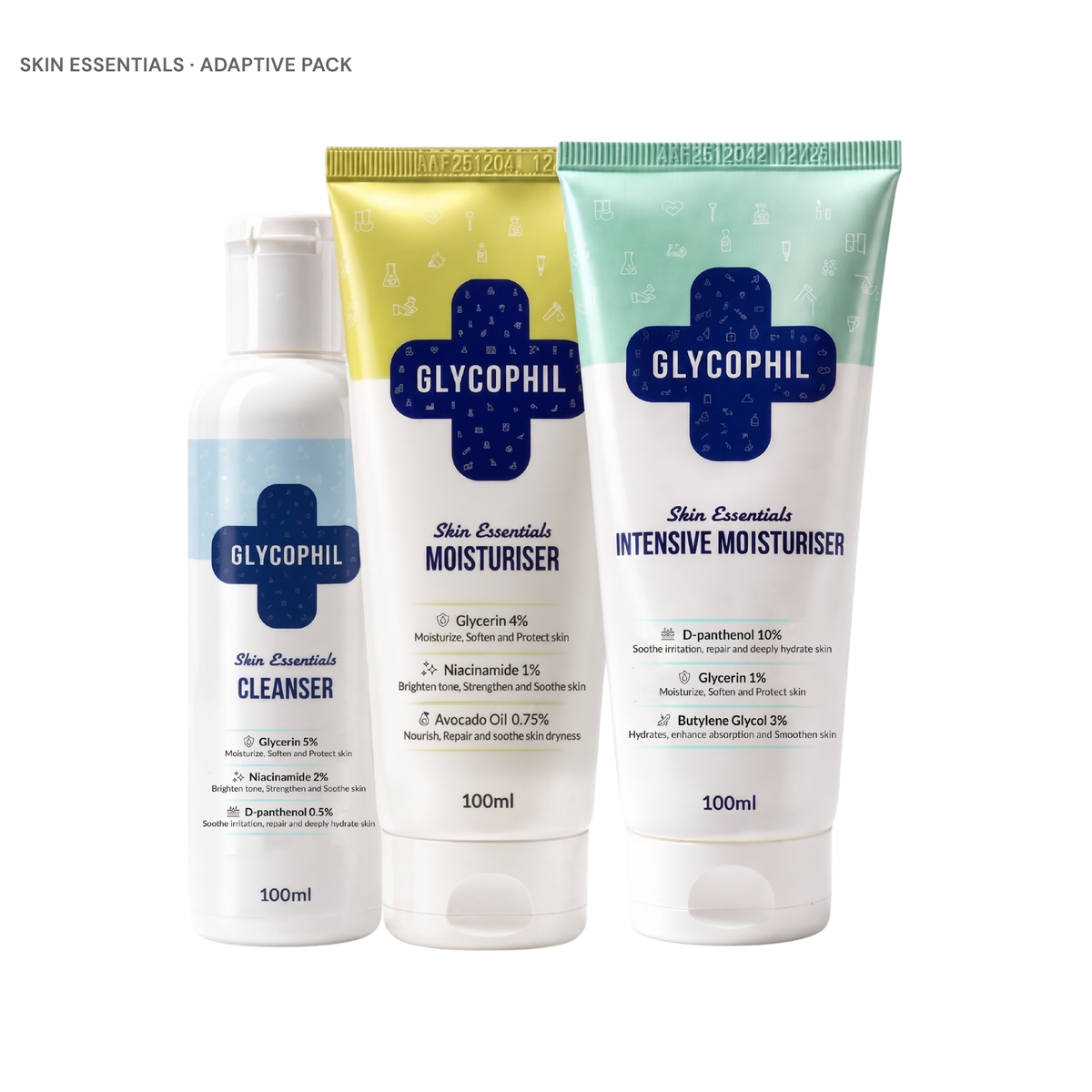
Skincare built for Skin Context. A cleanser that cleans without stripping. A daily moisturiser light enough for summer. An intensive moisturiser for the days your barrier is taking a beating.
Skin not responding the way you expected after 4 weeks?
Skin context varies. Write to care@glycophil.com with your routine notes. We'll work with you to figure out what your skin is asking for that this pack isn't giving. No judgement.
New to a clinical routine? Start with the Starter Pack at Rs. 499 →
Cleanser + Daily Moisturiser to begin. Add Intensive Moisturiser when you're ready for the full system.
What people are saying about the Adaptive Pack
I was looking for a summer moisturiser, thats when i came across this routine. I used to keep different products for different seasons. Now I just adjust between daily and intensive. Much simpler. Lets see how it performs in monsoons and winters.
bought this after seeing the summer ad of glycophil and let me tell you, this is one of the best routine you can have. simple and damn effective. cleanser is perfect, creamy and does not strip moisture. the daily moisturiser is one of the best moisturisers that you can use for day time application. the intensive moisturiser is less of a moisturiser and more of a barrier repair genie.
I was unsure if I needed both moisturisers, but now I get it. Daily for normal days, intensive when skin feels off. Every summer my skin would be red by the end of day but since i have started using this pack, it just feels normal.
Yes.
Transepidermal water loss, the rate at which water evaporates from your skin, increases significantly with temperature. A 2022 systematic review of 15 studies confirms it: hotter and more polluted environments raise barrier permeability, not lower it. Your skin produces more oil and loses more water at the same time. They are separate systems.1
Oil on the surface. Water leaving underneath. Both happening at once.
Skipping moisturiser in summer feels logical.The biology says otherwise.
When the weather is hot and your skin feels oily, adding moisturiser feels like adding fuel to fire. Most people skip it for weeks at a time. Some describe the feeling as "oily on the surface, tight underneath" — that's the experience your skin is trying to tell you about.
It's not asking you to wash more often. It's asking for water. The two are not interchangeable. Stripping the oil with a stronger cleanser doesn't replace the water. It accelerates the loss.
Here's what your skin does on a timeline you don't see day to day.
Your skin starts feeling different.
Mornings feel tight. Products that worked all year suddenly sting. Pigmentation darkens. Post-inflammatory hyperpigmentation can begin appearing within weeks of skin inflammation, and skin of colour is particularly susceptible.2
For now.
You start seeing it in the mirror.
Dullness sets in. Pigmentation spreads. Old acne marks refuse to fade. Epidermal post-inflammatory hyperpigmentation typically takes 6 to 12 months to resolve, often longer in darker skin tones. If the underlying conditions don't change, new marks compound on existing ones.2
Some of this stops being reversible.
A compromised barrier keeps the skin in chronic low-grade inflammation. When UV exposure adds to that, even at levels too low to cause sunburn, matrix metalloproteinase enzymes activate and break down collagen. The skin repairs each cycle, but the repair is imperfect. Year after year, the damage compounds into structural change.3
Some days the heat dominates. Some days the humidity. A long flight. An AC office. An outdoor wedding.
Your skin shifts in response to what's actually happening to it. The skin you have on a 38°C afternoon is not the skin you have after a six-hour flight. The skin you have after a polluted commute is not the skin you have after a quiet Sunday at home.
Treating it like it's the same every day is why most "summer skincare" doesn't move the needle.
This is what we call Skin Context.
A moisturiser that matches the day. Not the season.
One routine, calibrated to what your skin is actually doing today. Lighter on the days it doesn't need much. Heavier on the days it does. Same three products. Different deployment.
Skincare built on Skin Context, not skin type.
Built for what summer actually does to skin.
Glycerin.
A humectant — pulls water into the upper layers of the skin and binds it there. Works even as temperature rises and TEWL accelerates. Topical glycerin restores hydration and barrier function in clinical trials.4
Niacinamide.
Strengthens the barrier and reduces sebum overproduction. Also blocks melanosome transfer — the cellular process that drives pigmentation in darker skin tones. 35–68% inhibition in coculture models.5
D-Panthenol.
Converts to pantothenic acid (vitamin B5) inside the skin, providing raw material to rebuild barrier lipids from the inside. The same active used in clinical wound care to accelerate skin healing.6
Same active system across the range. Different concentrations. Different jobs.
What people are saying about the Adaptive Pack
I was looking for a summer moisturiser, thats when i came across this routine. I used to keep different products for different seasons. Now I just adjust between daily and intensive. Much simpler. Lets see how it performs in monsoons and winters.
bought this after seeing the summer ad of glycophil and let me tell you, this is one of the best routine you can have. simple and damn effective. cleanser is perfect, creamy and does not strip moisture. the daily moisturiser is one of the best moisturisers that you can use for day time application. the intensive moisturiser is less of a moisturiser and more of a barrier repair genie.
I was unsure if I needed both moisturisers, but now I get it. Daily for normal days, intensive when skin feels off. Every summer my skin would be red by the end of day but since i have started using this pack, it just feels normal.
Skin not responding the way you expected after 4 weeks?
Skin context varies. Write to care@glycophil.com with your routine notes. We'll work with you to figure out what your skin is asking for that this pack isn't giving. No judgement.
New to a clinical routine? Start with the Starter Pack at Rs. 499 →
Cleanser + Daily Moisturiser to begin. Add Intensive Moisturiser when you're ready for the full system.
The routine adapts. Here's what that looks like in summer.
Intensive Moisturiser is your default every night. In the morning, swap Daily Moisturiser for Intensive Moisturiser on days your skin's context has shifted.
Swap on mornings after: a long day in direct sun, a polluted commute, hours in AC, a flight, a wedding, an outdoor event, or any day where your skin was visibly working harder than usual.
Most people end up using Intensive Moisturiser in the morning 2 to 3 times a week in peak summer, and 1 to 2 times in shoulder seasons. The Intensive Moisturiser stays in PM every night, regardless.
3 products. 6 actives. 2 jobs.
Amino acid surfactants instead of sulfates. pH 6.2 to 6.6. Glycerin 5%, Niacinamide 2%, D-Panthenol 0.5%. Removes oil and dirt without stripping the lipid mortar that holds your barrier together.
Lightweight texture. pH 5.0 to 5.5. Fragrance-free. Glycerin 4%, Niacinamide 1%, Avocado Oil 0.75%. Hydrates without trapping oil that's already there. Built for summer wear.
Fragrance-free. Higher concentration of one specific repair active: D-Panthenol 10%. Plus Glycerin 1% and Butylene Glycol 3%. Used every night to support overnight barrier repair, and in the morning whenever your skin's context has shifted.
What people actually ask before buying.
Every batch independently assessed. Cosmetics-grade GMP manufacturing. No shortcuts.

glycophil.com/pages/the-science
References
- Green M., Kashetsky N., Feschuk A., Maibach H.I. (2022). Transepidermal water loss (TEWL): Environment and pollution — A systematic review. Skin Health and Disease 2(2):e104.
- Davis E.C., Callender V.D. (2010). Postinflammatory hyperpigmentation: a review of the epidemiology, clinical features, and treatment options in skin of color. Journal of Clinical and Aesthetic Dermatology 3(7):20–31.
- Fisher G.J., Wang Z.Q., Datta S.C., Varani J., Kang S., Voorhees J.J. (1997). Pathophysiology of premature skin aging induced by ultraviolet light. New England Journal of Medicine 337(20):1419–1428.
- Fluhr J.W., Darlenski R., Surber C. (2008). Glycerol and the skin: holistic approach to its origin and functions. British Journal of Dermatology 159(1):23–34.
- Hakozaki T., Minwalla L., Zhuang J., et al. (2002). The effect of niacinamide on reducing cutaneous pigmentation and suppression of melanosome transfer. British Journal of Dermatology 147(1):20–31.
- Proksch E., Nissen H.P. (2002). Dexpanthenol enhances skin barrier repair and reduces inflammation after sodium lauryl sulphate-induced irritation. Journal of Dermatological Treatment 13(4):173–178.