
Can oily skin be dehydrated?
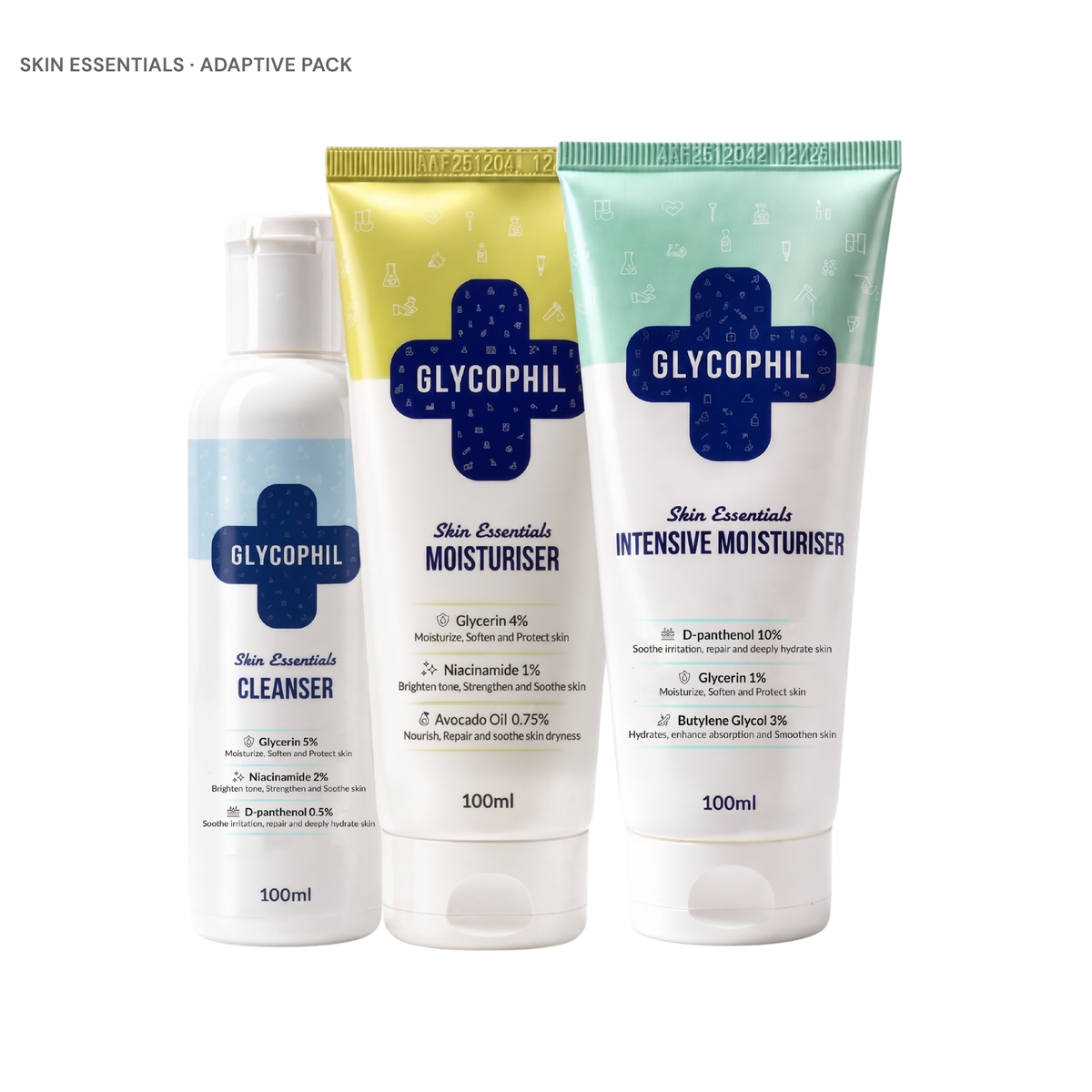
Skincare built for Skin Context. A cleanser that cleans without stripping. A daily moisturiser that hydrates without sitting heavy. An intensive moisturiser for when your barrier needs more.
Skin not responding the way you expected after 4 weeks?
Skin context varies. Write to care@glycophil.com with your routine notes. We'll work with you to figure out what your skin is asking for that this pack isn't giving. No judgement.
New to a clinical routine? Start with the Starter Pack at Rs. 499 →
Cleanser + Daily Moisturiser to begin. Add Intensive Moisturiser when you're ready for the full system.
Yes.
Sebum and hydration are two separate systems. Studies show the skin can produce excess oil and lose water through a compromised barrier at the same time. Low sebaceous activity does not correlate with skin dryness.1
And, it's a big problem.
Oily and dehydrated skin is one of the most common skin conditions in India.And one of the most misunderstood.
When the skin's barrier is compromised, the body compensates by producing more sebum as a protective response. The surface looks oily. The underlying state is depleted and ignored.2
The condition has a name now: dehydrated oily skin. But the products lining most pharmacy shelves still treat oil as the only problem. Strip more. Mattify harder. Wash twice. Each of those approaches deepens the cycle.
Products made for "oily" skin often make it worse.
Harsh surfactants strip both oil and moisture, damaging the barrier and triggering a rebound overproduction of sebum.2 The wash that promised to clear your face leaves your barrier weaker than before. Your skin compensates. More oil within the hour.
The product you use to take care of the problem actually ends up worsening it.
Most brands sell you a type. We built for context.
Most skincare assigns you a type. Oily. Dry. Combination. Sensitive. The label sticks. Brands sell you the same product for years.
Your skin doesn't sit still. The skin you have in monsoon is not the skin you have in winter. The skin you have after a flight is not the skin you have on a normal Tuesday. The skin you have after a stripped routine is not the skin you have after a week of rest.
Skin Context is the idea that you treat your skin for what it's doing right now, not for a label assigned to you years ago.
That's why this pack has three products instead of one. Cleanser for AM and PM. Daily Moisturiser hydrates in the morning. Intensive Moisturiser recovers your barrier overnight. On mornings when your skin's context has shifted, swap your AM Daily Moisturiser for Intensive Moisturiser.
What's happening below the surface determines what you see on it.
The cycle that keeps oily-dehydrated skin stuck.
A typical day is a day-long stress test on your skin's barrier.
Different lifestyles face different versions of these stressors. Office worker in AC, someone at home with a fan, outdoor worker, person in transit. The triggers vary. The biological consequence (barrier stress, water loss, compensatory oil production) is the same.
Two separate biological problems. Two specific solutions. One system that addresses both.
Hydrate without adding oil. Recover when the barrier has already been damaged. Adaptive Pack is built around these two jobs.
1. Hydrate, even when your skin feels "oily."
2% topical niacinamide reduces sebaceous gland output over four weeks.3 Topical glycerin restores skin hydration and barrier function in clinical trials.4
Niacinamide tells the sebaceous gland to make less oil. Glycerin pulls water into the upper layers of your skin and holds it there. Used daily, both ingredients reduce the dehydration that triggers oil production in the first place.
Moisturising doesn't add oil. It removes the reason your skin is making extra oil.
2. Recover, when the barrier has been damaged.
10% D-Panthenol improves stratum corneum hydration and accelerates barrier repair after surfactant-induced damage. The same damage stripping cleansers create.5,6
It doesn't sit on top of your skin. It penetrates into the upper layers and converts into pantothenic acid (vitamin B5). Your skin uses that B5 as raw material to rebuild its own barrier components from the inside.
D-Panthenol is the same active used in clinical wound-care formulations. At 10%, it's at the concentration associated with documented barrier-rebuilding effects.
Skin not responding the way you expected after 4 weeks?
Skin context varies. Write to care@glycophil.com with your routine notes. We'll work with you to figure out what your skin is asking for that this pack isn't giving. No judgement.
New to a clinical routine? Start with the Starter Pack at Rs. 499 →
Cleanser + Daily Moisturiser to begin. Add Intensive Moisturiser when you're ready for the full system.
The routine adapts. Here's what that looks like.
Intensive Moisturiser is your default for every night. In the morning, swap Daily Moisturiser for Intensive Moisturiser on days when your skin's context has shifted.
Swap on mornings after: a day in direct sun, a polluted commute, long hours in AC, a flight, a week of disturbed sleep, or coming back from a routine that stripped your barrier.
Most people end up using Intensive Moisturiser in the morning 1 to 2 times a week after the first month, once the daily routine has stabilised things. The Intensive Moisturiser stays in PM every night, regardless.
3 products. 6 actives. 2 jobs.
Amino acid surfactants instead of sulfates. pH 6.2 to 6.6. Glycerin 5%, Niacinamide 2%, D-Panthenol 0.5%. Removes oil and dirt without stripping the lipid mortar that holds your barrier together.
Lightweight texture. pH 5.0 to 5.5. Fragrance-free. Glycerin 4%, Niacinamide 1%, Avocado Oil 0.75%. Hydrates without trapping oil that's already there.
Fragrance-free. Higher concentration of one specific repair active: D-Panthenol 10%. Plus Glycerin 1% and Butylene Glycol 3%. Used every night to support overnight barrier repair, and in the morning whenever your skin's context has shifted.
What people actually ask before buying.
Every batch independently assessed. Cosmetics-grade GMP manufacturing. No shortcuts.

glycophil.com/pages/the-science
References
- Downing D.T., Stewart M.E., Wertz P.W., et al. (1987). Skin lipids: an update. J Invest Dermatol 88(3 Suppl):2s–6s.
- Li D., Zhou Z., Yang X., et al. (2025). A Comprehensive Review: The Bidirectional Role of Sebum in Skin Health. Bioengineering 12(12):1333.
- Draelos Z.D., Matsubara A., Smiles K. (2006). The effect of 2% niacinamide on facial sebum production. J Cosmet Laser Ther 8(2):96–101.
- Fluhr J.W., Darlenski R., Surber C. (2008). Glycerol and the skin: holistic approach to its origin and functions. Br J Dermatol 159(1):23–34.
- Ebner F., Heller A., Rippke F., Tausch I. (2002). Topical Use of Dexpanthenol in Skin Disorders. Am J Clin Dermatol 3(6):427–433.
- Proksch E., Nissen H.P. (2002). Dexpanthenol enhances skin barrier repair and reduces inflammation after sodium lauryl sulphate-induced irritation. J Dermatolog Treat 13(4):173–178.